
Dutch road signs explained: shapes, colours and every series
Dutch road signs follow two systems at once. The shape and colour tell you what kind of sign it is: round with a red border forbids, round and blue commands, a red triangle warns. The code tells you exactly which sign it is: the Dutch traffic regulations (RVV 1990) group every sign into series A to L, from A for speed to L for information. The theory exam uses those codes and shapes all the time.
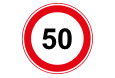

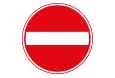
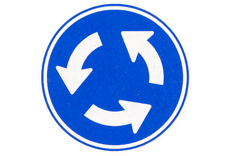

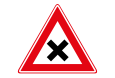
Shape and colour
| What you see | What it means | Example |
|---|---|---|
| Round, red border, white inside | Something is forbidden | C1 closed in both directions, F1 no overtaking |
| Round, blue, red border and stripe | No parking or no stopping | E1 no parking, E2 no stopping |
| Round, blue | Something you must do | D1 roundabout, direction to follow |
| Triangle pointing up, red border | Warning of danger ahead | J8 dangerous junction, J20 slippery road |
| Triangle pointing down, red border | Give way | B6 |
| Octagon, red | Stop and give way | B7 |
| Yellow diamond | You are on a priority road | B1 |
| Square or rectangle, blue | Information or a type of road | G1 motorway, L8 dead end |
| White with grey or black stripes | The end of a rule | F2 end of no overtaking, F8 end of all restrictions |
The series A to L
| Series | Official subject | Typical signs |
|---|---|---|
| A | Speed | A1 maximum speed, A3 matrix sign, A4 advisory speed |
| B | Priority | B1 priority road, B6 give way, B7 stop |
| C | Closed to traffic | C1 closed both ways, C2 no entry, C12 closed to all motor vehicles |
| D | Direction | D1 roundabout, D4 straight on only |
| E | Parking and stopping | E1 no parking, E2 no stopping, E10 parking disc zone |
| F | Other rules and prohibitions | F1 no overtaking, F2 end of it, F8 end of all restrictions |
| G | Traffic rules | G1 motorway, G3 autoweg, G5 erf, G11 compulsory cycle path |
| H | Built-up area | H1 start, H2 end |
| J | Warning | J8 dangerous junction, J20 slippery road, J21 children |
| K | Signposting | Direction signs |
| L | Information | L2 pedestrian crossing, L8 dead end |
Signs that are easy to mix up
- C12 is not no overtaking. C12 means closed to all motor vehicles; no overtaking is F1, and F2 ends it.
- B6 (upside-down triangle) means give way; B7 (octagon) means stop completely and then give way.
- E1 forbids parking, but you may stop briefly to let someone in or out; E2 forbids stopping altogether.
- A1 is a maximum you may not exceed; A4 is only advice.
Where a sign applies
A sign applies from where it stands. Many restrictions continue until a sign ends them, such as F2 for no overtaking or F8 for all restrictions. Zone signs, with ZONE above the sign, apply to a whole area until the end-of-zone sign. A sign above a lane can apply to that lane only.
Priority and speed signs come up on almost every exam. The rules behind them: priority rules in the Netherlands and speed limits in the Netherlands.
Frequently asked questions
How are Dutch road signs organised?
In series A to L in Annex 1 of the Dutch traffic regulations (RVV 1990): A speed, B priority, C closed to traffic, D direction, E parking and stopping, F other rules, G traffic rules, H built-up area, J warnings, K signposting and L information.
What does a round sign with a red border mean?
It forbids something: for example, closed in both directions (C1), no entry (C2) or no overtaking (F1). A round blue sign with a red border and red stripe is a parking or stopping ban (E1, E2).
What does a round blue sign mean?
It tells you what you must do, for example the direction you must take (D series).
What does a red triangle mean?
A warning of danger ahead, such as a dangerous junction (J8). An upside-down triangle is different: that is give way (B6).
Are Dutch road signs the same as in the rest of Europe?
Most shapes and colours follow the same European pattern. Some signs you may not know from home, such as the erf sign (G5): a residential zone where the limit is 15 km/h and pedestrians may use the whole street.
Sources, checked on 8 October 2026:
Written by Nawfal Serraji, traffic law specialist and founder of HaalTheorie.